Companies That Adopt Ai Hire More Senior Workers and Fewer Junior Ones
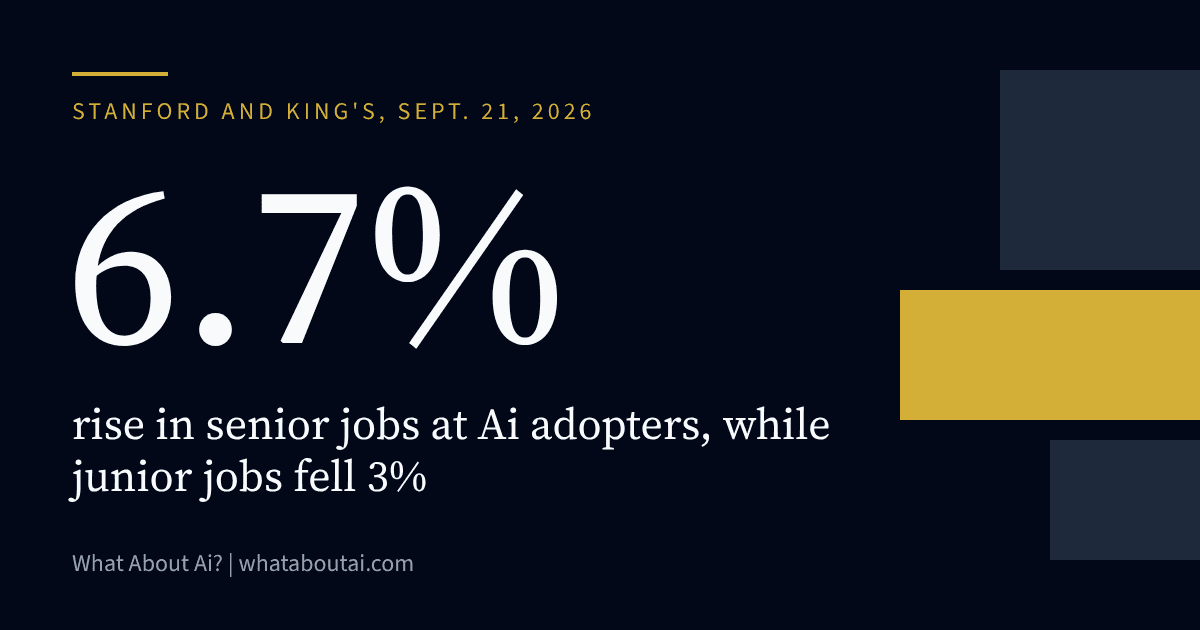
A study of 41 countries and 154 million employment records found senior employment rose 6.7% over five years at companies adopting Ai, while junior employment fell 3%. Here is what I would do with that.
A study of 41 countries and 154 million employment records found senior employment rose 6.7% over five years at companies adopting Ai, while junior employment fell 3%. Here is what I would do with that.
Source: What About AI? — James Perkins
J
Former Head of In-Store Payments at JPMorgan Chase, where he led a global payments organization. Serial entrepreneur and co-creator of FlashQoE, with 18+ years in payments and enterprise technology. Founder of What About AI?
What happened
Two researchers released a paper on September 21 about what happens to hiring after a company adopts Ai. The authors are Bharat Chandar of Stanford University and Bouke Klein Teeselink of King's College London. Bloomberg reported the findings the same day.
The data set is large. It covers 41 countries, 1.25 billion job postings and 154 million employment records, from January 2021 through March 2026.
At companies that adopted Ai, employment in senior positions rose 6.7% over five years. Junior employment fell 3% over the same period. The junior share of workers at those companies dropped 1.9 percentage points, even though overall hiring went up.
The pattern held in the jobs most exposed to Ai. Employment in computer and math roles rose 0.8 percentage points at companies that adopted Ai, and that gain also went toward senior workers. The shift away from junior workers showed up in countries including Brazil, Saudi Arabia and the UK, and the authors wrote that junior losses run somewhat deeper in richer and more digitized economies.
How I read it
My read is that companies using Ai are still hiring, and they are hiring people who can already do the job without training. The tools do the work that used to be given to a new hire, and the senior person checks it.
I managed a large engineering organization, and I think this creates a problem a few years out. Senior people come from junior people. A company that stops hiring at the bottom will run short of experienced staff later. That does not help someone who is 23 and looking for a first job today.
What I would do
If you are early in your career:
- Build proof that you can do work at the next level. Finished projects with real results count more than a list of courses.
- Use Ai tools to take on tasks a junior person would not normally get, and be ready to explain every line of what you hand in.
- Look at smaller companies and at employers that have not adopted Ai heavily yet. They still train people.
If you are senior, the numbers are in your favor for now. Use that time to become the person who reviews and directs Ai output on your team. You can check where your role stands in our job impact directory.
Sources
Have a question about this?
James reads every message and usually replies within a day.
Tags:#entry-level jobs#hiring#Stanford#senior roles#career advice
Check Your AI Career Risk
Take our free quiz to get a personalized assessment of how AI might impact your specific job and industry.
Take the Free QuizRelated Articles
Gallup: 36% of Frequent Ai Users Say Their Employer Now Expects More Output
A Gallup survey of 21,648 U.S. workers found 32% now use Ai at work a few times a week or more. Of those frequent users, 36% say expectations for daily output have gone up. Here is what I would do with that.
Employers Blamed Ai for 1,265 Job Cuts in October, the Lowest Month of 2026
Challenger, Gray & Christmas counted 1,265 job cuts that employers tied to Ai in October, the lowest month of 2026. The year-to-date count is still 121,401. Here is how I read both numbers.
Ai Was the Reason for 9% of September Job Cuts, Down From a Third in July
Challenger counted 43,281 announced job cuts in September and employers blamed Ai for 3,961 of them. Ai is still the top reason for the year at 120,136, and hiring plans were the weakest for a September since 2011.