Anthropic's Jobs Study: No Unemployment Spike, but Hiring of Young Workers Is Down 14%
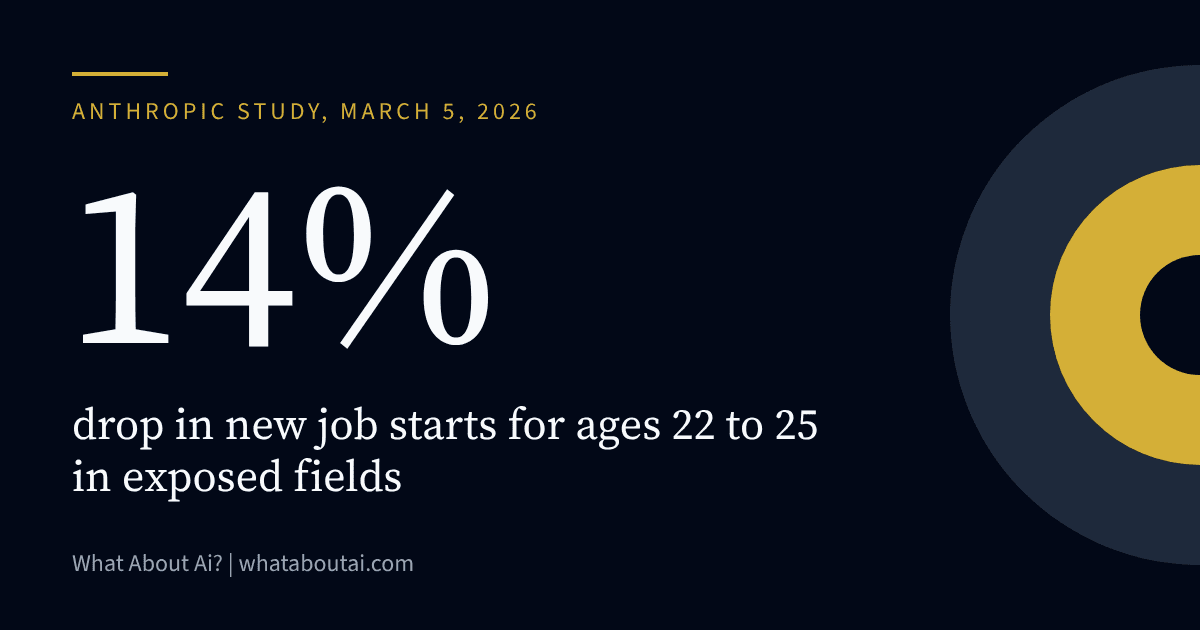
Anthropic published a study on March 5 that compares what Ai could do in each job with what people use it for. It found no rise in unemployment, and a 14% drop in new job starts for workers aged 22 to 25 in exposed fields.
Anthropic published a study on March 5 that compares what Ai could do in each job with what people use it for. It found no rise in unemployment, and a 14% drop in new job starts for workers aged 22 to 25 in exposed fields.
Source: What About AI? — James Perkins
J
Former Head of In-Store Payments at JPMorgan Chase, where he led a global payments organization. Serial entrepreneur and co-creator of FlashQoE, with 18+ years in payments and enterprise technology. Founder of What About AI?
On March 5, Anthropic published a study called "Labor market impacts of AI: A new measure and early evidence." The lead authors are Maxim Massenkoff and Peter McCrory. I read it because it uses real usage data from Claude and does not rely only on estimates of what Ai might do.
What the study found
The authors built a measure they call observed exposure. It takes the tasks in each occupation and checks how much of that work people are already doing with Claude. Automated use counts in full and assisted use counts as half.
Computer programmers came out highest, with 75% of their tasks covered. Data entry keyers were at 67%, and customer service representatives ranked second overall. About 30% of workers had zero coverage, including cooks, bartenders and motorcycle mechanics.
Then they looked at unemployment. They found no systematic increase for workers in the most exposed jobs since late 2022. The authors wrote that they see "limited evidence that AI has affected employment to date."
There is one exception. For workers aged 22 to 25, the rate of starting a new job in exposed occupations fell by about half a percentage point. That is a 14% drop compared with 2022. The authors say the result is only barely statistically significant, and they did not see the same drop for workers over 25.
How I read it
My read is that this matches what a hiring freeze looks like from the inside. I managed a large engineering organization, and when budgets get tight the first thing a company stops doing is opening junior roles. Nobody gets laid off, so it never shows up as unemployment. The people who feel it are the ones trying to get in.
I also noticed the gap between what Ai could do and what it is doing. In computer and math jobs, the study says Ai could in theory handle 94% of tasks, and observed use covers 33%. I think that gap will close, and the study gives no date for it.
One more number matters. Workers in the most exposed group earn 47% more on average than workers with no exposure. The exposed jobs are well-paid office jobs.
What I would do
- If you are early in your career in programming, customer service or data work, assume fewer openings and apply more widely. Add adjacent roles to your search.
- If you already have a job in an exposed field, learn the Ai tools your team is using now. The study shows the work is moving to those tools task by task.
- Look up your own job. Our job impact directory covers more than 290 roles.
I would not panic over this study, and I would not relax either. The unemployment numbers are calm. The hiring number for young workers is the one I will keep watching.
Sources
Have a question about this?
James reads every message and usually replies within a day.
Tags:#Anthropic#Ai and jobs#entry-level hiring#labor market#career risk
Check Your AI Career Risk
Take our free quiz to get a personalized assessment of how AI might impact your specific job and industry.
Take the Free QuizRelated Articles
Anthropic Adds Spreadsheets and Whiteboards to Claude. What Office Workers Should Do.
Anthropic put spreadsheets, whiteboards and data dashboards inside Claude this week. One customer says a 10 hour forecasting task now takes under 30 minutes. Here is what I would do if my job runs on spreadsheets.
Employers Blamed Ai for 1,265 Job Cuts in October, the Lowest Month of 2026
Challenger, Gray & Christmas counted 1,265 job cuts that employers tied to Ai in October, the lowest month of 2026. The year-to-date count is still 121,401. Here is how I read both numbers.
Barclays Will Cut 5,000 Jobs This Year and Says Ai Is Only Part of the Reason
Barclays expects to cut about 5,000 jobs in 2026, about 5% of its staff, and about 60% will come from support functions including developers. The CEO says older technology spending did most of it. Ai did less.